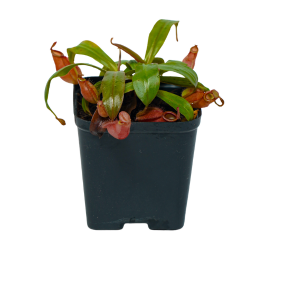
Nepenthes Red
Scientific Name: Nepenthes sp. 'Red'
Common Name: Red Pitcher Plant
Origin: Southeast Asia
Growth Rate: Moderate
Difficulty Level: Moderate
Temperature: 20–30°C during the day; 16–24°C at night
pH: 4.5–6.5
Humidity: 70–90%
Growing Medium: Airy, acidic, nutrient-poor medium
Bright, filtered or indirect light is recommended.
Moderate to high lighting encourages healthy growth and promotes deeper red coloration in the pitchers.
Adequate light is essential for strong pitcher development.
Avoid excessive direct sunlight and heat, particularly inside enclosed terrariums.
Low light may result in greener pitchers, slower growth, and reduced pitcher production.
Use RO, distilled, or rainwater with very low mineral content.
Keep the growing medium consistently moist but not waterlogged.
Water thoroughly and allow excess water to drain freely.
Avoid keeping the pot continuously submerged in water.
Do not use mineral-rich or hard tap water.
Prefers high humidity, generally around 70–90%.
Stable humidity supports continuous pitcher formation.
Performs well in humid terrariums and paludariums when combined with adequate ventilation.
Avoid stagnant, completely sealed conditions for extended periods.
Nepenthes naturally grows in nutrient-poor environments.
Avoid conventional fertilizers in the growing medium.
The plant obtains additional nutrients by capturing and digesting insects in its pitchers.
Small insects may occasionally be provided if natural prey is unavailable.
Avoid overfeeding or placing excessive food into the pitchers.
Requires a loose, acidic, moisture-retentive, and well-aerated substrate.
Suitable mixes include long-fiber sphagnum moss with perlite and orchid bark.
The substrate should retain moisture while allowing excellent drainage and root aeration.
Avoid garden soil, compost, manure, and ordinary nutrient-rich potting soil.
Commonly propagated through stem cuttings.
Select healthy stem sections containing suitable nodes.
Place cuttings in a moist, airy rooting medium and maintain high humidity.
Seed propagation is also possible but generally takes considerably longer.
Young plants should receive stable humidity and moderate lighting while establishing.
Best suited to the elevated terrestrial or background section of a terrarium or paludarium.
Can be positioned where its vines and pitchers have sufficient space to hang freely.
Excellent for vertical displays, backgrounds, and elevated planting areas.
Keep the root zone above standing water.
The contrasting red pitchers can serve as a strong focal element in a tropical naturalistic setup.
Disclaimer: Images are for visual representation and understanding only. Actual appearance may vary.