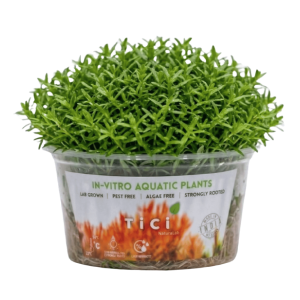
Scientific Name: Gratiola viscidula
Common Name: Gratiola Viscidula
Origin: North America
Growth Rate: Moderate
Difficulty Level: Moderate
Temperature: 20–28°C
pH: 5.5–7.5
GH: 2–12 dGH
KH: 0–8 dKH
Moderate to high lighting is recommended.
Strong lighting promotes compact growth and vibrant green coloration.
Under low light, stems may become elongated and less dense.
CO₂ supplementation is recommended for optimal growth.
Encourages bushier growth, stronger stems, and healthier foliage.
Can grow without CO₂, but growth may be slower and less compact.
Requires a consistent supply of macro and micronutrients.
Benefits from regular dosing of nitrate, phosphate, potassium, and trace elements.
Nutrient-rich conditions support healthy leaf development and steady growth.
Stable fertilization helps maintain dense and attractive growth.
Best suited for the foreground to midground.
Can be planted in groups to create dense, bright green bushes.
Works well as a transition plant between carpeting species and taller background plants.
Propagated through stem cuttings.
Cut healthy stems and replant them into the substrate.
New roots form readily, making propagation simple and effective.
Regular trimming encourages branching and compact growth.
Avoid excessive shading from taller plants.
Maintain stable nutrient and CO₂ levels for the best appearance.
Good water circulation helps keep the foliage healthy and algae-free.
Gratiola viscidula is an attractive stem plant valued for its fine-textured foliage and compact growth habit. Its bright green leaves provide excellent contrast against red plants, rocks, and driftwood, adding texture and depth to aquascapes. Commonly used in Nature and Dutch-style aquariums, it can form dense, bushy groups that create a soft and natural appearance. When provided with adequate lighting, nutrients, and CO₂, it develops into a lush, vibrant feature that enhances the overall balance and visual appeal of planted layouts.