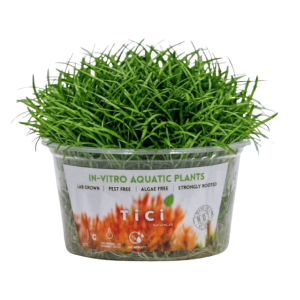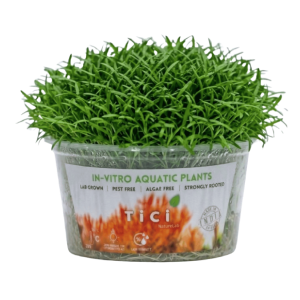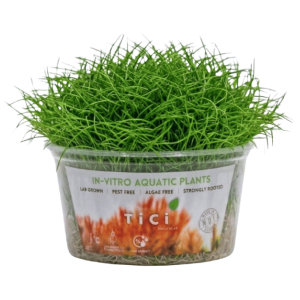
Scientific Name: Eleocharis acicularis
Common Name: Needle Spikerush, Hairgrass
Origin: Cosmopolitan (found across North America, Europe, Asia, and Australia)
Growth Rate: Moderate to Fast
Difficulty Level: Easy to Moderate
Temperature: 18–28°C
pH: 6.0–7.5
GH: 2–12 dGH
KH: 1–8 dKH
Moderate to high lighting is recommended.
Strong lighting promotes dense growth and faster carpet formation.
Under lower light conditions, the leaves may grow taller and less compact.
CO₂ supplementation is recommended for optimal growth.
Encourages rapid spreading, denser growth, and healthier foliage.
Can grow without CO₂, but growth will be slower and less vigorous.
Benefits from a nutrient-rich substrate.
Requires a consistent supply of macro and micronutrients.
Root fertilization supports healthy root development and sustained growth.
Regular nutrient dosing helps maintain vibrant green coloration.
Best suited for the foreground to midground.
Commonly used as a carpeting plant or to create grassy landscapes.
Taller than Eleocharis parvula, making it suitable for creating depth and natural transitions.
Propagated through runners.
Produces daughter plants that spread horizontally through the substrate.
Gradually forms dense colonies under favorable conditions.
Plant in small clumps with adequate spacing to encourage spreading.
Occasional trimming helps maintain a tidy appearance and stimulates new growth.
Ensure sufficient lighting reaches the base of the plant.
Stable nutrient levels and good water circulation support healthy development.
Eleocharis acicularis is a versatile grass-like plant valued for its fine, needle-shaped leaves and natural meadow appearance. It is widely used in Nature, Iwagumi, and biotope aquascapes to create lush grassy areas, soft transitions, and a sense of scale within the layout. Its delicate texture contrasts beautifully with rocks, driftwood, and broad-leaved plants, while its taller growth habit allows for greater depth and perspective. When provided with suitable lighting, nutrients, and CO₂, it develops into a vibrant green landscape that enhances the natural beauty of the aquarium.