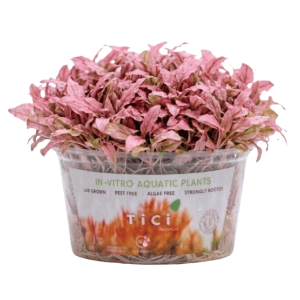
Scientific Name: Cryptocoryne wendtii 'Pink'
Common Name: Pink Wendtii Crypt
Origin: Sri Lanka
Growth Rate: Slow to Moderate
Difficulty Level: Easy to Moderate
Temperature: 22–30°C
pH: 6.0–7.5
GH: 2–15 dGH
KH: 1–10 dKH
Low to moderate lighting is sufficient.
Moderate lighting enhances the plant's attractive pink, bronze, and reddish-brown coloration.
Under lower light conditions, the plant remains healthy but may display more subdued colors.
CO₂ supplementation is not essential.
Additional CO₂ promotes faster growth, larger leaves, and richer coloration.
Adapts very well to low-tech aquariums.
Primarily a root-feeding plant.
Benefits greatly from nutrient-rich substrates and root tab supplementation.
Requires adequate nitrate, phosphate, potassium, and micronutrients for healthy development.
Regular fertilization supports stronger growth and improved leaf coloration.
Best suited for the foreground to midground.
Ideal for creating natural clusters around rocks and driftwood.
Works well as a focal accent plant in smaller aquariums.
Propagates through runners.
Daughter plants develop near the parent plant and can be separated once established.
Gradually forms dense colonies under favorable conditions.
Avoid frequent relocation, as Cryptocoryne species prefer stability.
Nutrient-rich substrate significantly improves growth and coloration.
Allow sufficient space around the plant for runner development.
Stable water parameters help prevent transplant stress.
Cryptocoryne wendtii 'Pink' is a beautiful rosette plant valued for its unique pink, bronze, and reddish-toned leaves. Its compact growth habit and adaptability make it an excellent choice for both beginner and advanced aquarists. Commonly used in the foreground and midground, it provides attractive color contrast against green aquatic plants while adding texture and depth to Nature, Dutch, low-tech, and biotope aquascapes. With stable conditions and a nutrient-rich substrate, it develops into a lush, eye-catching feature within the aquarium.